Reports Database:
AÇEV Child and Family Centers’ Programs in Earthquake Affected Region Social Return on Investment Analysis Report
Executive Summary
The report provides an in-depth analysis of the social impact of the programs implemented by the Mother and Child Education Foundation (AÇEV) in its centers in the earthquake affected region between June 2023 and August 2024. Prepared using qualitative and quantitative research methods within the framework of Social Value International’s Social Value Principles, this analysis reveals the transformative impact of the programs on various stakeholders in qualitative and quantitative terms and presents the social value of this impact and the social return on investment.
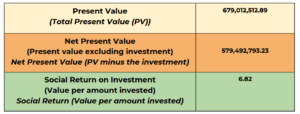
According to the analysis results, it was determined that AÇEV generated 6.82 TL of social value (SROI ratio 1:6.82) for every 1 TL of resources invested in the program.
The Social Return on Investment (SROI) approach aims to reveal the social value experienced by stakeholders by expanding the analytical perspective to quantitatively address less tangible effects that are often overlooked in existing economic analyses.
Unlike the rigid economic (efficiency) returns (direct or indirect) offered by cost- benefit analyses, the SROI approach captures more by considering all impacts (both tangible and intangible) that stakeholders themselves consider valuable. Such an approach allows for the expression of typically qualitative outcomes in quantitative terms, enabling the identification of issues such as psychological recovery in the post-traumatic process, increased confidence as a parent, and the defense of women’s rights.
The SROI approach complements and integrates the findings of AÇEV’s 2005 report, “Cost-Benefit Analysis of Preschool Education in Turkey,” providing a more comprehensive picture. In this context, the fact that the interventions addressed the stakeholders in the aftermath of the post-traumatic experience of the earthquake, adds another dimension to early childhood and parental empowerment. Programs targeting early childhood, as mentioned in the literature, have been proven to achieve critical goals such as reducing post-disaster trauma and accelerating the normalization process (UNICEF, 2011; PreventionWeb). The results of the prepared SROI report also demonstrate that these goals have been achieved.
The graph-1 below shows the percentage of value created for all stakeholder groups.
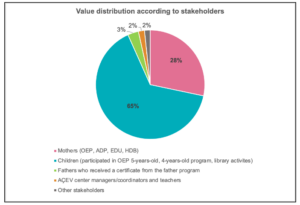
The distribution of this total social value clearly demonstrates that the program has achieved its primary objectives. 65% of the total value was experienced by children participating in early childhood education programs, indicating that this group experienced the most change in their cognitive, social, and emotional development. The second group of stakeholders experiencing the most change was mothers. While 28% of the total value represents the changes experienced by mothers, the third group experiencing the most change, at 3%, was fathers who received certificates from the father program.
The analysis reveals that among stakeholders with high participation levels, significant outcomes were observed, particularly in terms of “psychological well- being,” going beyond the AÇEV’s main area of work on children education. These findings are consistent with scientific evidence (Shonkoff et al., 2012; PMC) that early childhood education and care services provide psychological and cognitive protection by buffering the negative impacts of trauma on neurodevelopment in children exposed to trauma.
The report identified some negative changes experienced by employees (decreased socialization, psychological fatigue, less hope for the future) and showed that supporting employees in post-disaster environments is a critical area of learning. In light of these findings, it is recommended that AÇEV Child and Family Centers be seen as a fundamental investment in post-disaster recovery and, considering the high value they create, be prioritized for scaling in future recovery and development plans.