Reports Database:
Football Cooperative – Social Return on Investment (SROI) Evaluation Analysis
Executive Summary
In 2017, Football Cooperative (FC) was established and uses ‘pick up’ football to bring men together to play football and to improve their overall health and wellbeing. It allows men to partake in a competitive game of football, which is offered twice weekly in the evenings on an all-weather AstroTurf pitch. FC is run by volunteer coordinators who organise the games as well as participate in the games. The values that FC is driven are the cultivation of community, inclusivity, sportsmanship and life-long learning. The FC initiative is promoted via social media and ‘word of mouth’ and is continually open to new members of all ages and abilities. By the time of writing of this report, FC had grown to have 807 registered members across two sites in Ireland, and the vision is to scale up the FC model to bring ‘pick up football’ games to men in communities across Ireland and beyond to reduce isolation and to improve their overall health and well-being at a population level.
The purpose of this evaluation was to assess the feasibility for scale up of the FC initiative using a social return on investment (SROI) methodology. Various sections of the report below explain how the steps in the SROI approach were addressed including the research design, participant recruitment, data collection and analysis approaches.
A total of four stakeholders were initially identified; this included the participants, their family unit [significant others], the volunteer coordinators and the community partners who manage the facility where games are played. Outcomes for participants were measured via a pragmatic quasi-experimental one site repeated measures study over a 12-month period. A range of data was collected from all stakeholders using a combination of physical measures collected onsite, focus groups, surveys and interviews. Theories of change were developed for each stakeholder group which led to validated outcomes with each group and these outcomes included physical, mental and social benefits for the participants as well as increased injuries. The data was segmented to see if outcomes varied across different criteria and it was found that participation levels of the participants exerted an influence on the reported outcomes.
To value the respective outcomes of each stakeholder group, survey data gathered at 12 months [administered via the FC gatekeeper] was used for each stakeholder and various discounts [deadweight, displacement, attribution and drop off] were than applied before arriving at a final SROI calculation. Table 2.1 below details the various outcomes for each stakeholder group along with the total input costs for each group leading to a final SROI for the FC initiative as €17.60 for every €1 invested.
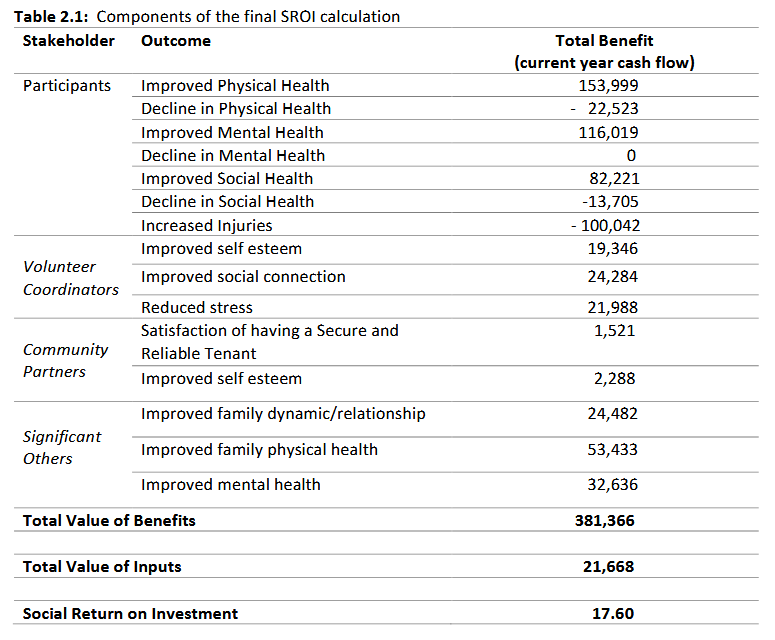
Following sensitivity and scenario analysis, the final SROI was found to range from €14.08 and €26.14 for every €1 invested and the report below adopts a prudent approach to valuation to avoid being seen to over-claim for benefits. The strong positive SROI calculation can be seen as a strong endorsement of the value-for-money offered by FC and the advisory board has thus adjudicated that the FC initiative is feasible for scale up, with plans underway to develop an implementation strategy for same.”