Reports Database:
Social Return on Investment Report (SROI) – Taichung Veterans General Hospital
Program Background
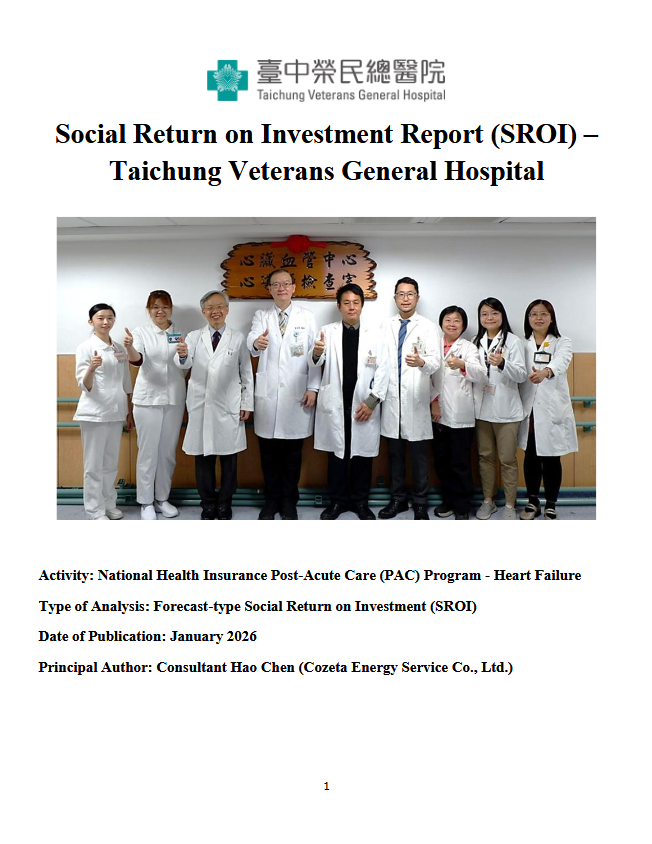
This report analyzes the program “National Health Insurance Post-Acute Care (PAC) Program – Heart Failure”, with Taichung Veterans General Hospital (TCVGH) serving as the main implementing institution. TCVGH is responsible for case enrollment, care delivery, team integration, and performance reporting. This program aims to provide a six-month integrated care service for hospitalized patients aged 18 and above with a left ventricular ejection fraction (LVEF) ≤ 40% and clinically stable conditions (NYHA Functional Class II~III) after discharge. The hospital also conducts a one-year follow-up period, which includes regular outpatient visits with specialists, remote monitoring, mobile app tracking, nutritional and rehabilitation guidance, and family caregiver support. The goal is to enhance patients’ self-care ability and overall quality of life, while reducing the risk of rehospitalization and acute deterioration.
Since 2014, Taichung Veterans General Hospital (TCVGH) has established a dedicated Heart Failure Department. In 2017, the hospital launched a Post-Acute Care (PAC) program for heart failure patients, forming a multidisciplinary team composed of cardiologists, nurses, dietitians, physical therapists, social workers, and case managers to provide integrated outpatient care services. As one of the first medical centers in Taiwan to adopt an integrated care model for heart failure, TCVGH demonstrated the program’s effectiveness during the 2018–2019 pilot period. The hospital successfully reduced the six-month hospital readmission rate from 50% to 1.5%, highlighting the significant social value and potential for broader dissemination of this care model.
This program aligns with the overall Post-Acute Care (PAC) policy direction promoted by the National Health Insurance Administration, Ministry of Health and Welfare (NHIA), emphasizing a continuum of care that transitions patients from the acute phase to post-acute recovery and eventually to chronic stabilization. The objective is to enhance medical efficiency, improve patient outcomes, and strengthen the long-term sustainability of the healthcare system. Taichung Veterans General Hospital intends to apply the Social Return on Investment (SROI) methodology to forecast and analyze the potential social impact and value creation resulting from the implementation of this program. The findings will serve as empirical evidence to support future policy refinement, system expansion, and outcome-based performance evaluation.
Social Return on Investment Analysis Method
“National Health Insurance Post-Acute Care (PAC) Program – Heart Failure” has established a comprehensive clinical monitoring framework. This includes functional improvement indicators such as ADL and the 6-minute walk test, as well as readmission and mortality rates. It has also built an integrated care process through cross-institutional collaboration. In addition, subjective tools such as the Minnesota Living with Heart Failure Questionnaire (MLHFQ) are used to assess quality of life. However, these indicators mainly reflect internal clinical performance and cannot fully capture the overall social benefits experienced by patients, families, caregivers, medical teams, and policy stakeholders. Social Return on Investment (SROI) helps fill this gap. By involving stakeholders, constructing theory of chain of events, translating outcomes, and estimating value, SROI makes otherwise “hard-to-measure” benefits tangible.
This program uses SROI analysis to reveal the following core social values:
- Patients regain self-worth and social participation through stability and functional recovery.
- Families experience improved quality of life and relationships due to reduced caregiving burden.
- Medical teams enhance professional fulfillment and competency through collaborative care.
- Evidence-based confirmation of social benefits enables the National Health Insurance Policy Division to advance policy development and scale implementation
Accordingly, this report uses a forecast-type SROI analysis. It combines clinical and non-clinical indicators to measure social value across patients, families, medical teams, and policy makers. This approach addresses the limitations of current tools and offers a solid, scalable, and communicable basis for public health policy.
This program applies a forecast-type Social Return on Investment (SROI) analysis to assess the impact and quantify the value generated by the “National Health Insurance Post-Acute Care Integrated Program — Heart Failure,” implemented at Taichung Veterans General Hospital (TCVGH). The forecast-type SROI is especially appropriate for policies and service programs that are still underway or not yet fully scaled. It programs potential future social value based on current outcomes and initial stakeholder feedback, providing an essential basis for ongoing investment, institutionalization, and policy refinement.
Patient enrollment in this program was conducted on a rolling basis, and the care process itself may extend across multiple calendar years. To ensure consistency, this report analyzes cases from the full year of 2022 as the foundation for model construction. The analysis adheres to the SROI Principles and Assurance Standards published by Social Value International (SVI). Key steps include identifying stakeholders, constructing chains of events, monetizing outcomes, adjusting for deadweight, attribution, drop-off, and displacement, and re-evaluating the expected duration of outcome. Finally, the analysis calculates the overall SROI ratio and supplements it with qualitative findings and risk assessments.
Through the use of a forecast-type SROI model, Taichung Veterans General Hospital aims to empirically demonstrate the multifaceted value generated by the Post-Acute Care (PAC) program for patients, caregivers, medical teams, and policy-making bodies. This approach is intended to strengthen stakeholder communication, while also serving as a critical reference for future resource allocation under the National Health Insurance system and for the broader dissemination of integrated care models.
Analysis Period and Scope
The analysis covers the period from January 1, 2022 to December 31, 2022. This year was selected as the analysis period because it was the first full year after COVID-19 had become normalized. During this year, patient enrollment was sufficient, care pathways were complete, and data availability was high. Moreover, the majority of patients completed their primary medical care and remote follow-up within the same year, making it both representative and meaningful for forecasting. In addition, since patient enrollment for this program was conducted on a rolling basis, many patients’ actual care spanned across calendar years. Analyzing data from 2023 and beyond would be unfavorable for modeling and validation, as care would be incomplete and indicators unstable. Therefore, this report focuses on data from 2022 as the sample basis for the forecast-type SROI model.
The geographical scope of this program primarily centers around Taichung Veterans General Hospital, located in Xitun District, Taichung City. The patient population predominantly comes from Taichung City, Nantou County, Changhua County, and Miaoli County. Both acute and post-acute care are provided within TCVGH, which operates a dedicated heart failure outpatient clinic offering integrated care services. Accordingly, the social value assessed in this report reflects the real-world context of the program, including patients’ living environments, healthcare-seeking behaviors, and resource distribution across the aforementioned regions.
Purpose and Audience of the SROI Report
This report is produced from the “National Health Insurance Post-Acute Care (PAC) Program – Heart Failure” implemented by Taichung Veterans General Hospital. A forecast-type Social Return on Investment (SROI) analysis is applied to assess the multifaceted social value generated during the program’s actual implementation. This includes improved patient health, better caregiver quality of life, stronger team effectiveness, and policy-level benefits. The report is structured in accordance with international social value standards (Social Value International), aiming to present non-financial impacts in concrete, monetized terms as a common language for policy and practice communication.
The report is intended for:
- NHIA: As the policy authority, NHIA can use the findings of this report to review the effectiveness of the current integrated care practice. These findings can also serve as a basis for future expansion, institutionalization, or adjustments to the subsidy mechanism.
- TCVGH internal decision-makers and care teams: This report can serve as a reference tool for cross-institutional review and forward-looking planning. It strengthens the perceived value of teamwork and helps internal stakeholders understand the implicit benefits brought by non-clinical indicators.
- Collaborative Care Partners: By presenting the impact pathway and benefit dimensions revealed in this report, the program aims to enhance shared understanding among collaborative care members regarding the overall effectiveness of the initiative, thereby strengthening motivation for continued implementation.
- Third-party verifiers and researchers: Developed through standardized methods and a logical model, this report provides a foundation for validation and communication. It also serves as an empirical case to support the future promotion of SROI analysis in healthcare sector.
Through this report, TCVGH hopes to deepen the healthcare system’s understanding of the social benefits of integrated care. It also aims to help relevant institutions obtain more persuasive quantitative evidence and practical experience to support the implementation of value-based care policies.