Reports Database:
Social Return on Investment (SROI) Evaluation Report of Standard Foods Corporation’s LOHAS with Love Plan
ABSTRACT
This study applies the Social Return on Investment (SROI) methodology to evaluate the social value generated by the LOHAS with Love plan initiated by Standard Foods Group. The evaluation focuses on the program’s impact on key stakeholders, including disadvantaged elderly, community elderly, social welfare organizations, frontline social workers, and Standard Foods Group itself. Through nutrition education and nutritional support activities, the program aims to improve the health and quality of life of elderly participants while enhancing the social impact of Standard Foods Group and its partners.
The research process follows the eight principles of Social Value International (SVI), identifying and quantifying program outcomes through stakeholder interviews, quantitative surveys, and data analysis. Impact adjustment factors—deadweight, attribution, displacement, and drop-off—are incorporated to ensure objectivity and accuracy in value calculation.
This evaluation focuses on the 2024 LOHAS with Love plan, assessing the social impact generated between June 1, 2024, and February 28, 2025, from the perspective of stakeholders. Five major stakeholder groups were identified: Standard Foods Group, social welfare organizations, frontline social workers, community elderly, and disadvantaged elderly.
The results show that the LOHAS with Love plan produced positive outcomes across all stakeholder groups. For disadvantaged elderly, the program improved physical functioning through nutritional supplements and health promotion activities, reduced financial pressure from daily expenses, and enhanced their overall quality of life. Community elderly improved their nutritional knowledge by participating in Food Education Workshops, and these learning experiences also fostered social interaction and contributed to improved mental and physical well-being.
For frontline social workers, participation in the program generally led to increased work efficiency and reduced psychological stress due to their ability to provide more effective services. At the organizational level, the program raised the visibility of social welfare organizations and attracted more external support, including material donations, fundraising, and human resource involvement—fostering sustainable development. For Standard Foods Group, the program strengthened the company’s public welfare brand image and enhanced its positioning in the nutrition field, further expanding its social influence.
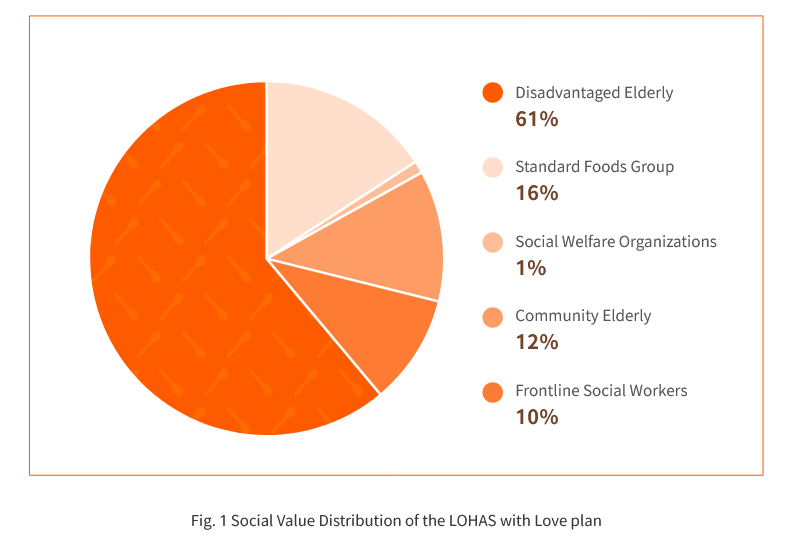
The primary beneficiaries of the program’s overall social impact are disadvantaged elderly, accounting for 61%, followed by Standard Foods Group at 16%, community elderly at 12%, frontline social workers at 10%, and social welfare organizations at 1%. This distribution aligns with the program’s core objective—placing sustainable actions for disadvantaged elderly at the center of its mission.
The final calculation indicates that the total present value of the program’s social impact is NT$39,860,222, while the total input cost is NT$7,637,989. This results in an SROI ratio of 5.22:1, meaning that every NT$1 invested generates NT$5.22 in social value. According to the sensitivity analysis, the SROI value in this study ranges from 3.62 to 6.52 under different assumptions and scenarios.